Jared Ritchey: Index Faster in Google with WordPress

Jared Ritchey has a few things to say about search engine optimization and WordPress.
Jared Ritchey has a few things to say about search engine optimization and WordPress.
If you are reading this post, then congratulations...you are now seeing CMS Report on its new server (a Virtual Private/Dedicated Server). As I tweak the VPS in the following weeks, I may fall back on the old server from time to time but for the most part, I'm home. Today officially ends my grand-experiment of running a moderately busy Drupal site on the cheap.
I just can't believe the year Drupal is having. There has been an explosion of Drupal sites almost everywhere you turn. Drupal is very popular with the masses in 2007. So popular in fact, that I wonder as with all things popular if we'll be seeing 2008 as the backlash year against Drupal as it has quickly evolves as a litmus test for open source CMS (one of my predictions for 2008).
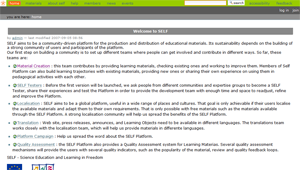
The latest Drupal-based site to flash on the screen of my browser is the portal (currently in beta) for the European Commission sponsored Science, Education and Learning in Freedom (SELF ) project. The site aims to be a community-driven platform for the production and distribution of educational materials. Its sustainability depends on the building of a strong community of users and participants of the platform. The site may actually be live by the time you read this post.
It is my non-bias opinion that Jared Ritchey may be one of this century's finest writers. Oh let's just choose a random post as an example and see what he has to say regarding content management systems.
I love well rounded and informative information. Bryan Ruby, the author, publisher, webmaster for CMSReport.com has a SPANK of good information and resources regarding many of todays top CMS solutions on the web.
My thanks to Jared for the nice compliment. Most of Ritchey's other posts at his Wordpress site focus on Web design. The content of those posts make a visit to his site well worth the time.
Mike Gifford, Open Concept, commented here at CMS Report that his company had just posted a report they did for a client comparing three open source content management systems. His company needed to recommend to their client whether Wordpress, Joomla, and Drupal would be a good replacement for their current CMS, Back-End (BE).
To be honest, I've had problems getting excited in the past about XOOPS as a CMS or as an open source community. There just didn't seem to be a whole lot of buzz about this CMS and I was seriously thinking about dropping it from my personal "top 30 list" found to the left under "CMS Focus".
 A couple weeks ago, I found on my doorstep Hagen Graf's book, Building Websites with Joomla! 1.5 Beta 1. The book was sent to me by the book's publisher, Packt Publishing, in hopes that I would review the book on the Joomla! content management system here at CMSReport.com. While I do not promise to review every book or Internet link that comes my way, I always appreciate the opportunity to do such reviews. In this case, I was eager to review the book since I have lost track of the new features introduced in version 1.5 since Joomla!

What seems like a very long time since I first heard about and ordered the new Drupal book, Pro Drupal Development, it finally arrived at my doorstep. So far, I have only read Chapter 1, "How Drupal Works", and glanced at the remaining pages of the book but I'm very impressed. The book is written in a very easy, well organized, and informative writing style.
At first I was skeptical that this article was without bias regarding Wordpress.com since it was Matt Mullenweg's own blog that referred me to the story. I was pleased to discover that the author, Jonathan Bailey, helped erased my skepticism in his well written article, Wordpress.com is Virtually Spam Free. The first two paragraphs should get you interested in reading more.
This past week saw updates for both Wordpress and Wordpress MU. While both open source packages are blogging applications they are not quite the same software. Wordpress MU is intended to run up to hundreds of thousands of blogs with a single install of WordPress. Hence the MU in Wordpress MU stands for Multi-User.
A security update is available in both branches of Wordpress as 2.1.3 and 2.0.10.