Software Development

Building A Website: I Am The Client

I've mentioned on this blog a few times that CMSReport.com was never really meant to be a business or publication. It just happened. Six years ago, I started this journey I'm on with just my fascination for information systems and the little knowledge I had obtained on my own about content management systems. I was hungry to learn more and I started this site simply as a place to store my personal notes, bookmarks, and possibly share ideas with a few others. As many of you know, a lot has happened since the early years and I've been at crossroads for how to take CMS Report to the next level.

Jahia Launches Jahia 6.6

Jahia 6.6 raises User Experience building to a new standard and further enhances the strengths of the platform 

Washington DC, USA - Jahia, provider of Java-based open source next generation CMS solutions, announced today the new version of its flagship CMS product in version 6.6 with two major areas of improvements: the platform management and Jahia Studio, its visual integration tool to build highly customized and personalized User Experiences.

Jahia Studio, a new standard of User Experience Building

Joomla 2.5 to be released soon

The release of Joomla 2.5, a popular open source content management system, is expected to occur within the next few weeks. This release gives Joomla! fans a reason to celebrate and those new to the CMS a chance to consider Joomla! for thier next project. Like clockwork, the Joomla community is preparing the way by educating the masses on the new features and enhancements included in this version. I'm not an expert on the Joomla! development process, but I'm going to do my best here in summarizing the information that I've gathered so far on Joomla 2.5.

How CMS Websites are Overcoming Modern Day Development Challenges

CMS websites are now the norm as the preferred content management and delivery solution. Nevertheless, many CMS web applications face scalability issues. However, when a CMS is put in the cloud, it theoretically resolves the scalability issue to obtain a complete benefit.

But, if a cloud platform is not configured to match the particular needs of the CMS, it will need to work harder. This will result in higher loads than what is actually needed to serve the incoming traffic. Therefore, in most cases, it is sensible to cache the static content. The issue that one faces here is whether the cloud is able to tell the difference between a user who has signed into an application and is therefore being served with dynamic content and the one who has not yet signed into the application.

At the same time, a CMS presents many other challenges other than scalability due to the paradigm shift from the traditional model of sharing files from a central repository.  The reason behind this is that websites no longer operate isolated or in standalone mode. They must be able to interact with a range of other business applications that range from ecommerce business solutions to CRM databases to a range of reporting as well as analytics tools. To cut a long story short, websites have become increasingly data and content hungry because of their complex nature and the requirements of their users.

Managing such websites is now a full-time job.  Earlier in the traditional hosting scenario, the site owner had to figure out how to look after the application, but also the servers, backups, databases, and others.  Now, the platforms are specialized, so handling a web application which was a full time job can now be addressed by a person who can pay full-time attention.

Book Club: Pro Drupal 7 Development

As I mentioned in a previous post, I'm currently playing catch-up in discussing all the good books sent my way this past year. Many of the books have been sent by the authors and publishers themselves for review and some of the books I've bought on my own dime. There should be no further evidence that I'm a procrastinator in posting book reviews than this particular review of Todd Tomlinson and John K. Vandyke's Pro Drupal 7 Development. This book was published almost a year ago, and I'm only now finding the time to blog about this book.

New OpenCms 8.0.3 available from Alkacon

OpenCms 8.0.3 is now ready and available for download.

OpenCms is one of the most popular Open Source Content Management Solutions. This new version was developed by Alkacon Software GmbH with the support of the international OpenCms developer community.

OpenCms 8 contains a greatly improved user interface for content managers and numerous other enhancements.

With OpenCms 8.0.3, many important and useful additional features and improvements have been added to the core system and a number of issues that persisted in the 8.0.2 release have been fixed.

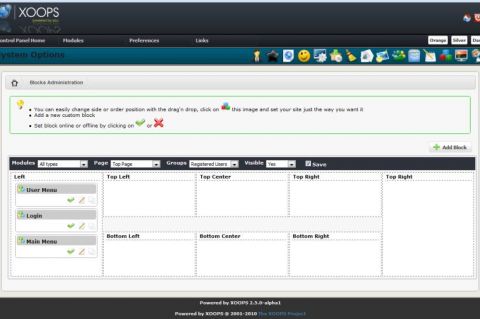
XOOPS 2.5.2 RC released

The XOOPS Development Team is pleased to announce that a new version, XOOPS 2.5.2 RC, is available for download.

This release is focused on fixing bugs from previous versions and on security. As a result, over 60 bugs have been fixed, as well as several new enhancements have been added, among them:

  • improved Captcha system
  • improved Protector module with links to stopforumspam 
  • improved PM (private messaging) module

For more info and download please click here

XOOPS Logo

Packt announce Finalists for 2011 Open Source Awards

Yesterday, Packt Publishing announced the finalists for their 2011 Open Source Award. This announcement signals the start of the next stage where the finalists are now open to public vote, which lasts until October 31.

Not all the categories in the award are content management related, but if you have an interest in open source I think you'll find each one of the finalists have a great story to tell. The finalists, listed in alphabetical order across all the categories, are as follows:

Open Source CMS Award

SilverStripe Framework Will Stand Alone

SilverStripe Ltd. is due to release SilverStripe CMS 3.0 in alpha in October and beta by the end of the year. The biggest change to the current content management system will be the separation of the SilverStripe Framework as it’s own entity. The framework as a stable basis, formerly known as ‘Sapphire’, enables the developer to build more than just traditional websites and potentially build applications for any device and any purpose.