What Is Facial Verification? A Complete Guide to Secure Online Identity Verification
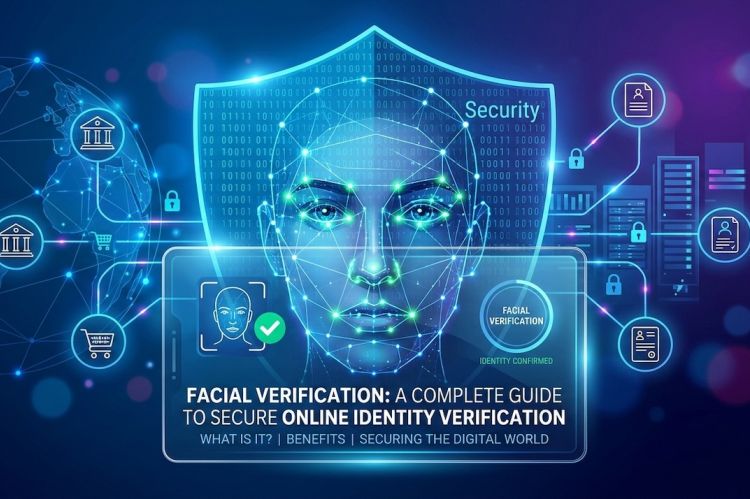
With companies shifting their services to the internet, the importance of customer authentication has become a highly serious issue. Banking, fintech, cryptocurrency, e-commerce, and healthcare are some of the industries where the digital identity verification system has become more and more popular, as they are seeking to conduct their operations without fraud and regulatory violations. Facial verification is one of the best technologies that facilitates this change.
Facial verification helps organizations to verify that a particular individual is who they purport to be through the analysis of distinctive facial characteristics. By comparing a live image or selfie with a previously stored image, usually one of those in a government-issued ID, businesses can identify users in seconds and securely during the process of digital onboarding. The technology is significantly used in present-day identity verification systems and is extensively applied to enhance Know Your Customer (KYC) processes.
The guide details the concept of facial verification and its functionality as well as the reasons why organizations are embracing facial verification solutions to protect their online platforms.
Facial Verification: What it is and how it works.
Facial verification is a biometric system that establishes the identity of an individual through comparison of 2 facial images. Facial verification compares two pictures to determine whether they belong to the same person unlike facial recognition that identifies a person among the mass of data in a database.
Indicatively, where a user would subscribe to a financial service online, he or she might be requested to provide a picture of his or her ID and live selfies. The system further compares the facial features of the selfie with the photo on the ID card by analyzing facial features, including the distance between the eyes, the shape of the jawline and other distinctive features, to establish whether the selfie is the same as the one on the ID card.
The process is usually incorporated into facial verification KYC procedures to determine that the account creator is indeed present and provision of his own identity documents.
The Theory of Facial Verification
The majority of contemporary systems of facial verification are based on high-quality artificial intelligence and machine learning algorithms, which can analyze the facial data in a short period of time and with high precision. There are a number of steps that are usually involved in the verification process.
To use it, the user sends a live selfie with the help of a smartphone or a web camera. This measure is used to ensure that an actual human being is involved when doing the verification. Liveness detection is also done by many systems that make sure that the image is not a photo, video, or mask.
Second, both the live image and the ID document photo are extracted and the features of the faces are extracted by using the system. These characteristics are transformed to mathematical patterns called biometric templates.
Third, the system matches these templates in order to find out whether the two pictures are of the same individual. In case the score of similarity is within the required level, the verification of the identity is achieved.
Since the whole process is done within a few seconds, a trusted facial verification service will help businesses to register customers within a few seconds without sacrificing security.
The Importance of Online Security: Facial Verification
As more services go online, online fraud and identity theft have grown tremendously. The conventional verification of identity systems like passwords or fixed personal data is no longer an effective measure to avoid impersonation attacks.
Facial verification also offers another level of security where there is physical verification of the user during authentication. Biometric traits are not duplicable like traditional credentials since they occur in each person.
Facial verification solutions help organizations mitigate the risks of frauds which may include identity theft, synthetic identity frauds and account takeovers. Businesses can use this by matching the face of a user to an official form of identity, and thus confirm that the person communicating with the business is an authentic user.
This feature is especially valuable to financial institutions, where identification checks are rigorous according to the regulatory systems.
KYC Compliance Facial Verification
The Know Your Customer (KYC) policies compel financial organizations and online platforms to confirm customer identities prior to service delivery. Facial verification has become an important part of the current facial verification KYC.
Facial verification, when combined with document verification as well as database checks, will ensure that:
The individual who posts the identity document is the owner.
The individual is present physically in the process of onboarding.
The identity employed is not stolen or faked.
Facial verification and KYC processes will help organizations simplify their onboarding process and remain within the boundaries of regulations.
In the case of fintechs, digital banks, and cryptocurrency exchanges, a secure facial verification service will allow balancing between security, compliance, and user-friendliness.
The important advantages of Facial Verification Solutions.
The application of facial verification technology in digital identity verification is taking place quickly among the businesses due to its many benefits.
Enhanced Security
Facial verification is a crime prevention tool that ensures that the identity fraud is avoided by confirming that the person who created or accessed an account is physically present and corresponds to the official identity paper.
Faster Customer Onboarding
Verification of identity manually may consume hours, or days. Facial verification solutions are automated enabling companies to authenticate users in a few seconds enhancing the customer onboarding process.
Regulatory Compliance
KYC and anti-money laundering regulations have to be adhered to by many industries. Facial verification helps in fulfilling such needs by enhancing identity authentication procedures.
Improved User Experience
Users are fond of fast and convenient ways of onboarding. A smooth face recognition service will enable the customer to authenticate themselves with a simple smartphone camera.
Reduced Operational Costs
Automation will help in cutting down of manual document review and verification crews and cuts business operation costs.
Selecting the optimal Face Verification System.
Organizations that would like to ensure the protection of their online existence have to select the most appropriate facial verification solution. There are many issues to be taken into consideration when rating a provider.
One of the factors that are very important is accuracy. Its solution must employ the state-of-the-art AI models that are able to pick up slight differences in faces and reduce false identifications.
Another important feature is liveness detection. This technology denies the fraudsters the opportunity to pass checks with photos, videos, or deepfakes.
Speed and scalability is also issues, especially when it comes to the businesses that can have many customer registrations. The optimal facial verification system must be able to provide the results within a few seconds and provide high user traffic.
Lastly, there should be prioritization regarding compliance and data security. Dependable providers make sure that biometric information is coded and handled as per the international data protection standards.
The Future of Face Recognition.
Facial verification technology keeps on changing with the development of artificial intelligence and biometric studies. Facial verification will achieve even higher accuracy, speed, and popularity in industries in the next few years.
From banking and fintech to healthcare, gaming, and e-commerce platforms, organizations are increasingly relying on facial verification solutions to secure their digital ecosystems.
As cyber threats grow more sophisticated, businesses must adopt stronger identity verification systems to protect both their customers and their platforms. By integrating a robust facial verification service into their identity verification workflows, organizations can enhance security, improve user experience, and maintain regulatory compliance in the digital age.